13 December 2013

Family Tree DNA Webinars with Elise Friedman


Family Tree DNA now offers webinars for learning the basics of genetic genealogy. These webinars, conducted by Elise Friedman, are FREE.  Ms. Friedman been doing DNA webinars for a few years through her website Relative Roots


This first webinar’s agenda was a wonderful overview of the basics of using DNA for genealogy and included these points:

What is Genetic Genealogy
Brief History of Genetic Genealogy
DNA Bases and Inheritance
Overiew of Family Tree DNA
Y-chromosome tests
mtDNA tests
autosomal tests Family Tree DNA Projects
More Family Tree DNA Resources
Announcements and Wrap UP
Q & A

The webinar gave clear examples and explanations for using DNA testing to supplement your traditional genealogy.  Ms. Friedman’s presentation provided quality information in a clear and concise manner without a lot of technical jargon.

Her future presentations will focus on the three types of tests: Y-chromosome (Y-DNA), mitochondrial DNA (mtDNA) and autosomal DNA (atDNA) in the next couple of weeks.  Watch the Family Tree DNA Facebook page for dates and times.

In the near future, Family Tree DNA will have the schedule posted on their site.

Click to view this webinar  for the next few weeks.

Take advantage of this great learning tool and see how DNA testing can help your genealogy.

Wonderful idea Family Tree DNA!!!

Enjoy,
Emily

10 December 2013

And the FTDNA Features just keep rolling along….


Family Tree DNA has begun notification on a weekly (no doubt when it applies) updates to their system.  This is greatly appreciated as changes requested by the genetic genealogy public are coming quickly.  


This week we have two changes: 
1.  Being able to clear their map coordinates for their oldest known maternal and paternal lines as that person can change as we add information to our lineages.
2. Using a matrix for Family Finder matches to determine if two or more of your matches match each other.

The Family Finder Matrix feature is extremely important in finding half-identical regions (HIRs) which allow you to map your chromosomes and determine a possible common ancestor.

Background:
      Each of our 23 chromosomes is actually a pair of chromosomes since we receive one from mom and one from dad, but the current chromosome comparison features do not indicate that each chromosome is actually a pair. This is partially due to not knowing which of the pair came from which parent. Determining which parent gave which chromosome in the pair can only be clarified after testing relatives and / or finding common ancestors with your matches or from phasing a parent(s) and child. Although viewing DNA segments with your matches using a chromosome comparison feature is an important step in finding a common ancestor, it is more important to determine the half-identical regions you share with your matches.
      Where you match someone on one of the pair in any chromosome is referred to as a half-identical region.  This is the region or segment along one of the copies of a chromosome (either the one from mom or the one from dad) where at least one of the two bases (A, G, T, C) of a person’s test results match at least one of the two bases from a different person's test results. This match should be throughout the entire HIR segment.
       If you wish to locate the common ancestor you share with a match or learn which ancestor gave you the DNA segment, you must determine the half-identical regions you share with your matches. If you are comparing two or more matches with your DNA results, you must determine which half-identical region you share with those matches and which they share with each other, if any. Testers must match on the same half-identical region in order to have the same common ancestor. The new Family Finder Matrix can help.

Family Tree liaison Rebekah Canada has sent the following message from Family Tree DNA:

Weekly Information Technology/Engineering Update 

(10 Dec 2013)

Matches Maps Locations Clear Button


Some users have requested the ability to clear their stored map coordinates for their most distant known maternal or paternal ancestors. We have added a Remove Location button to Step 3 of the Update Most Distant Ancestor’s Location wizard.


Family Tree DNA myFTDNA BETA Family Finder – Matrix


Today, we are happy to release our new BETA Family Finder – Matrix page. The Matrix tool can tell you if two or more of your matches match each other. This is most useful when you discover matches with wholly or partly overlapping DNA segments on the Family Finder - Chromosome Browser page.
Due to privacy concerns, the suggested relationship of your two matches (if related) is not revealed. However, we can tell you whether they are related according to our Family Finder program. To use it, you select up to 10 names from the Match list on the left side of the page and add them to the Selected Matches list on the right side of the page. A grid will populate below the lists. It will indicate whether there is a match (a blue check mark) or there is not a match (an empty white tile).

You access the BETA Family Finder – Matrix page through the Family Finder menu in your myFTDNA account.


The page starts out with two list areas: Matches and Selected Matches. You add Matches to the Selected Matches list by clicking on a name and then on the Add button.


Here is a screenshot of the BETA Family Finder – Matches page with a few matches added to the Selected Matches list.


 You can change the order of names in the matrix by clicking on a name and then either the Move Up or the Move Down button.


WOW...Family Tree DNA is listening to its customers and quickly applying their requests.  What more could you ask!  Thank you FTDNA!

Explore the new features now, before more come rolling along and you get behind! 

Enjoy,
Emily

05 December 2013

23andMe vs FDA: No DNA Health Tests Being Sold

Greetings!

It appears the FDA is moving quickly.  As of today 23andMe can no longer sell DNA kits for health purposes.  Perhaps this will change if things are resolved with the FDA, but that could take much time.

When you first open 23andMe the following message appears.  You must click that you understand the information before you can actually login.  This appears only once.


The above form letter states:


Welcome to 23andMe.

At this time, we have suspended our health-related genetic tests to comply immediately with the U.S. Food and Drug Administration’s directive to discontinue new consumer access during our regulatory review process.

We are continuing to provide you with both ancestry-related genetic tests and raw genetic data, without 23andMe’s interpretation.

If you are an existing customer please click the link below and then go to the health page for additional information. If you are a customer that purchased before 11/22/13, you will still have access to your health-related results.

We remain firmly committed to fulfilling our long-term mission to help people everywhere have access to their own genetic data and have the ability to use that information to improve their lives.

Upon entering the site, please confirm you understand the new changes in our services.

I understand that 23andMe only sells ancestry reports and raw genetic data at this time. I understand 23andMe will not provide health-related reports.  However, 23andMe may provide health-related results in the future, dependent upon FDA marketing authorization.

I UNDERSTAND


After clicking the green button below the message (see photo above) which says "I UNDERSTAND", you are taken to the home page for selling kits.  The kit price is still $99, but there is no mention of any health testing.

IF the FDA's issues with 23andMe can be resolved and the company can resume selling DNA health kits, the path would be cleared for other companies.  However, if 23andMe either has to cease selling the health tests or has to modify their system greatly, there is concern about how profitable the company will be, given that it has always been structured around a focus on health rather than on genealogy.  In the meantime, it is also possible that more restrictions may be placed upon the company. We shall have to see.

Depending upon the outcome, their entire business model may need changing and/or their website. No doubt the FDA has 23andMe's ear now, and no doubt 23andMe will scramble to comply.  They have no choice.  BUT just what will be required of them is the question  What compromise, if any, can be reached.

Regardless, this can be a handicap to genealogists.  Many genetic genealogists have reported that even though people have tested for health reason, they often become interested in genealogy.  Given this, all of us are losing.

The genetic genealogy community is watching all this very carefully...

Emily


Family Tree DNA Updates Website

Family Tree DNA has updated their site using the requests presented to them by the genetic genealogists at their yearly conference in Houston this last November.  These change,s as promised, have happened in record speed!  HAPPY DANCE!

All of the following were among the requests, and there are more requests slated to come!  This is a very exciting time to see that Family Tree DNA is listening to the project administrators who are greatly involved in using the website features I the best possible ways to assist in dealing with genealogical brick walls.

The announcement stated:

Today we are releasing some great updates that were requested during our 9th International Conference on Genetic Genealogy.  Here is a quick summary with some screen shots of what to expect.

ftdna 12-4
1. The timeout for myFTDNA has been increased from 30 min to 2 hrs.  This will benefit everyone but will especially be appreciated by our Group Admins when they are impersonating into a kit.
2. Changed the word “Triangulation” to “Common Matches” for Family Finder matching.
ftdna 12-4 2
3. Instead of using the word “Steps” on the matching pages we will now use “Genetic Distance.”  This will effect both the Y-DNA and mtDNA matching pages.
ftdna 12-4 3
4. Fixed the Interactive Tour.  It was getting stuck at the Family Finder section but will now complete.
ftdna 12-4 4
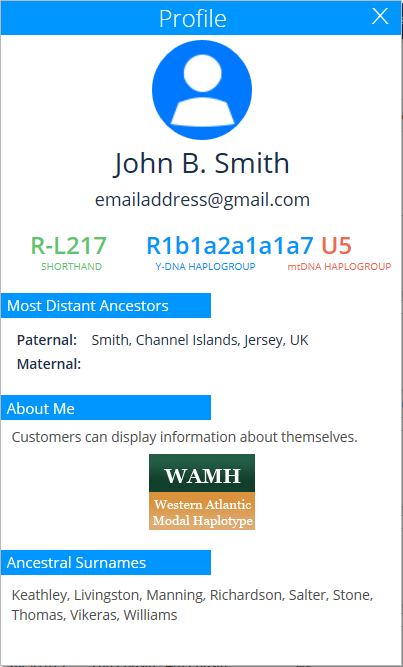
5. Updated the Profile Pop up on matching pages with a new design and restored the “About Me” section and badges.  This profile is available on all matching pages:  Y-DNA, mtDNA, Family Finder, and Advanced Matching.
ftdna 12-4 5
6. Added the ability for a user to download chromosome browser data for all of their matches.  This new option is towards the top right side of the chromosome browser page and will be in Excel format.

YEAH for these changes, especially number one an six since administrators are often timed-out before our work is complete AND the latter change allows everyone to download the chromosome browser data for all of our matches at once instead of five at a time! HAPPY, HAPPY DANCE!!!

Although some of these changes may seem minor, they are all very helpful...and the real point is this:  Family Tree DNA is listening to the needs of genetic genealogists who know best how to use DNA testing for their family research.  These changes reflex needs that make the lives of voluntary project administrators easier as well as clarify the process for the DNA users.

All of us are very anxious to see the rest of the proposed list addressed in the coming months, and are very hopeful that most, if not all, of the suggested changes will be implemented.  

AND, how many companies do you know that listen to consumer needs with positive action?  I can't name any other.  

Looking forward to the future!
Emily


03 December 2013

23andMe vs. FDA

Over the last week or so there has been a great deal of discussion with the announcement that the FDA is asking 23andMe to "cease and desist".  The genetic genealogy community has been watching all this very carefully.  We are not being alarmists, but cautious. Some of those genetic genealogists are familiar with the workings of the FDA on these matters and some are knowledgeable about 23andMe in general.  There is agreement that we need to move on all this.

I have waited to post about the FDA confronting 23andMe as other bloggers have done a very fine job keeping everyone current, and I wanted to be certain there was movement toward curbing 23andMe.  Now there is.

I realize that some of you may just be on AncestryDNA or Family Tree DNA, but most of you have done 23andMe and perhaps all three.

I know I have recently asked for emails from those who match me and am trying to get everything on 23andMe in order as this FDA project isn't going away.  23andMe has just pulled all their online ads for their affiliate programs.  You know, those links that get you something if someone orders a test through the link on your site.  The middle link tells you what to do for your account.

Anyway, I strongly urge you to read all of the following links from blogger Roberta Estes:

Please ask for emails from all your testers and to share BASIC genomes.  If you match me and we are not sharing emails or BASIC genomes, please send an invitation to do so and send me your email.

ALSO, consider transferring your test results to Family Tree DNA to be in another database for several reasons:
1. You get additional matches and at this site you do not have to invite people as you see their email and names.
2. We just don’t know to what exist the FDA will push their “cease and desist” order.

ALSO, know that 23andMe has had plans to upgrade their chip (at least before all this and they still may once this is resolved).  The new chip is not compatible with Family Tree DNA and with AncestryDNA so to join those groups now may be a good thing.  Family Tree DNA's cost to transfer from either 23andMe or AncestryDNA is on sale for $49 until Dec 31.

Do spread the word.  Altough some of us paid hundreds of dollars for this test while those new to all this paid $99 or got it free through one of the 23andMe programs, none of us want to lose what we have obtained.  

Hope this helps,
Emily
aulicino@hevanet.com

20 November 2013

Adoption Success Story

Another wonderful DNA Success Story!

It all started with a letter I found among my mother’s papers after she died in 1971. She had been born in 1918 in New York City. The letter, dated July 30,1948, was typed on letterhead stationery from “The Spence-Chapin Adoption Service.” I knew my mom had been adopted. In fact, her 2 brothers and sister were not biological siblings but were also adopted. They all grew up in Milwaukee, Wisconsin. However, it was news to me that my mom had corresponded with the adoption agency, and that she had requested her birth certificate. I think, if the request had been granted, my mom would have received an amended birth certificate listing her adopted parents, not her birth parents.

The request had been denied. The explanation: “The reason for the difficulty seems to be that your mother [birth mother] had a different name put on the birth certificate than is on the order of adoption and we were unable to prove that the name Helen Grant which is on the order of adoption is the same person as Helen Moore, the name in which your birth is registered.”

I held onto the letter with the idea that sometime I might be able to complete this goal for my mom, but raising a family of six children myself, I let many years pass by before I took the goal seriously. When I did, I found that the Spence-Chapin Adoption Service was still in business in New York City, and I contacted them to request non-identifying information. I was told they would have to search for the file, and it took about 9 months, but finally an administrator phoned. They had found the file. Although I was only entitled to non-identifying information, the information they gave me coupled with the information I already had from the 1948 letter gave me some hope.

I made some assumptions, which could have been incorrect. I assumed that the surname “Grant” was probably my mom’s birth mother’s maiden name, and that the surname “Moore” was probably the surname of my mom’s unknown birth father. There was some evidence to support this theory. For example, the agency spokesperson told me that my mom’s birth grandmother was with her daughter when the adoption papers were signed. It seemed likely that they would have used the family name. On the other hand, the birth grandmother may not have been present in the hospital when the birth certificate information was given.

 The non-identifying information given to me by the adoption agency included these facts: My mom’s birth mother was 18 at the time of the birth. She was unmarried, not yet self-supporting, living with her family in the southeastern U.S., and unable to be a parent at this time. Knowing only that the birth family lived in the southeastern U.S. was not very helpful, so I asked if the agency representative could tell me the state. She told me “Mississippi.”

Meanwhile, my son was waiting for the birth of his first child and knew she was a girl. They were considering some family names, so I asked the agency spokesperson if I could know the birth mom’s first name, and I was told, “Marion.”

I had been referred to an adoption “angel,” who had also been adopted out of New York City. She had some knowledge of the process and a great desire to help me. She had access to the index of birth registrations in New York City during the time my mom was born there. She discovered that there is a birth registration for an un-named female baby Moore, born on my mom’s birthday (November 20, 1918) in New York City. The index did not include any other information, but I was thrilled. This could be the birth record referred to in the 1948 letter. It could be the record that the adoption agency had been unable to find because they had been told that the birth was registered under the name of Helen Moore. My adoption angel and I tried every way we could to obtain the long version of the birth certificate. We were unsuccessful.

New York City is notoriously unwilling to share vital records with anyone who isn’t the person involved or the person’s parents. There was a small chance that I could get the record if my last name were “Moore” or if I could provide notarized copies of documents showing my relationship to “Moore.” I concluded that, without a lawyer and a $5,000 fee, there was no hope in New York City.

I communicated with the Wisconsin government agency which provides assistance to adoptees looking for birth parents. The case worker was able to locate the record of the court adoption proceedings, and she even sent me a copy, but the name of the birth mother and any identifying information had been expunged. Apparently my mom’s adopted father, who was an attorney, had insisted that the records were sealed. Again, the only way to get more information involved a lawyer and lawyer’s fees.

I turned to the U.S. census records of Mississippi. Knowing that the birth mother was 18 at my mom’s birth was helpful, but there were still considerations. Since my mom’s birthday was late in the year (Nov. 20,1918), her mom’s birth date could have been in 1900 if she had a Jan. through Nov. 20th birthday. Or if her birth date were Nov. 20th through Dec. 31st, she would have been born in1899. Of course, census records show ages as of the enumeration date, and often the ages are incorrect depending on how knowledgeable the informant was. I was interested in the 1910 census, which had an enumeration date of 15 Apr 1910.

Searching for information on U.S. censuses has become easy, using ancestry.com and
FamilySearch.org. It took some diligence, but I finally found a “Marion Grant,” living in Meridian, Lauderdale County, Mississippi. In April,1910 she was 9 years old, and I now knew her parents’ names.

This opened flood gates of possibilities. I was unable to find a birth record on FamilySearch.org, but when I searched the public member trees on ancestry.com, I found a couple of trees that listed “my” Marion. These gave me the fact that Marion was married about 10 years after my mom’s birth. Thus I discovered Marion’s married name. These trees listed interesting facts about the Grant family. I discovered that my mom’s possible birth grandmother (Marion’s mother), Frances Pitts Grant was an accomplished composer and pianist. I investigated this fact further and discovered that there are a number of her compositions in the Special Collections of Tulane University. This was especially interesting to me because my mother was an excellent pianist from a very young age. It strengthened the hope that I had found the right person.

I waited impatiently for the release of the 1940 U.S. Census. I hoped fervently that Marion’s listing would occupy line 14 or 29 of the 1940 census because these people were required to answer supplementary questions. These questions included “Number of children ever born.” I needn’t have wasted any time worrying about whether Marion would be truthful or not because she didn’t have to answer the supplemental questions. The census did reveal that a son “Dave” had joined the family.

I turned to newspaperarchive.com and discovered an obituary for Marion. She had died of a heart attack in Tuscan, Arizona in 1954. I used the death date to search and find a death certificate in Arizona records online. The death certificate provided me with her birth date:  November 9th, 1900. Reading Marion’s obituary gave me more information about her son, but I was hesitant to contact him without more definitive evidence.

I had been reading success stories about adoptees finding birth parents with DNA testing. I looked at the Family Tree DNA website, and I noticed that there is a Pitts Family project. Marion Grant’s mother was Frances Pitts Grant. I sent in my sample, and I hoped to uncover a connection that would give credibility to my theory. When the results came in the connection was not clear. A connection wasn’t ruled out, nor was it confirmed. For one thing, my mtDNA haplogroup was U5a1h, which is so rare that there were no others in the FTDNA database of more than 168,000 mtDNA records.

Nancy and David, the Pitts DNA Project administrators, encouraged me to contact my mom’s possible half-brother. If he agreed to testing, and if he were my half-uncle, then the connection would be very apparent. He would be the only person on FTDNA to share my rare haplogroup. Nevertheless, I was hesitant because I didn’t have strong proof, and I didn’t want to cause him emotional trauma. Nancy and David explained that my half-uncle’s mtDNA came from his mother Marion. My mtDNA came from my mother, who got her mtDNA from Marion. The two should be identical or nearly identical. However, my half-uncle’s children would not have Marion’s mtDNA. They would have gotten their mtDNA from their own mother.

With support from my family, I took a deep breath and wrote a letter to the person I hoped was my half-uncle. It turned out that he knew nothing about the idea that his mom had a baby prior to himself, but he was a very nice person. He agreed to give the DNA test a try, and ordered the mtdna Full Genetic Sequence.

I think he was very surprised when the DNA proved our relationship, but he says he is thrilled to include my family in his, and my family is thrilled too. Finally, I have another person with the U5a1h haplogroup, and I also have a newly discovered half-uncle. The Family Finder test confirmed the relationship at: 1st Cousin, Half Siblings, Grandparent/Grandchild, Aunt/Uncle, Niece/Nephew. It is a wonderful feeling.

Signed: Tish S.

Thank you Tish for sharing this and thank you David, co-admin of the Pitts DNA Project,  for notifying me of this wonderful story!

Emily

13 November 2013

2013 Family Tree DNA International Conference, Day 2


Day 2
The annual International Society of Genetic Genealogy (ISOGG) meeting started today with a review.  ISOGG was born out of the 2004 FTDNA conference.  This self-supporting volunteer organization is free to anyone and only asks that you share your knowledge about DNA testing for genealogy.  Katherine Borges, director, mentioned that the ISOGG Wiki page is very active and that there is a new page for administrators who wish to sponsor tests can be listed.  Some DNA projects raise money to sponsor tests. The Wiki is a great source and you are welcome to use anything within its pages as long as you cite your source.

ISOGG has been a presence at Who Do You Think You Are? (WDYTYA) for many years.  This is the world’s largest genealogical conference and is held in London every February.  Besides this, ISOGG has had a table at Southern California Genealogical Society’s DNA Day held one day before Jamboree in June.  Many ISOGG members gave presentations and the day was a great success.  ISOGG also held a stand in Back to the Past (BOTP) in Dublin, Ireland this October.  This was the first presence there and Family Tree DNA also attended.  Again, another great success.

Alice Fairhurst reported that in 2006 the Y-SNP tree began.  SNPs were pulled from academic papers primarily. The following timeline shows the growth.

2006 – 436 SNPs
2008 – 790 SNPs
2010 – 935 SNPs
2012 – 2067 SNPs
Sept 2013 – 3610 SNPs

With the advent of the Big Y test which covers 25,000 SNPs, that number is now much larger.

The Journal of Genetic Genealogy (JOGG) was founded the same year as ISOGG, but has not been operating for over a year.  Katherine is seeking to put JOGG under the ISOGG umbrella, if needed, in the near future.

A DNA conference will be held August 16-17, 2014 in Washington DC.  Watch for coming news.


Michael Hammer’s presentation Implications of the 2014 Y Tree focused on the origins of some R1b subclades and with more testing the origins and migrations are altering. Dr. Hammer demonstrated that the current perception of R1b haplogroup migrations may have originated in the Near East before coming to Western Europe >5,000 years ago. Other haplogroups tend to show some other interesting patterns, although sample sizes are small at this time. Dr. Hammer called upon citizen scientists to help gather the needed data for further study by continuing to SNP test.

Marja Pirttivaara in Bridging Social Media & DNA shared her success with her Finland DNA Project and how to use social media to assist a DNA project.  She covered some privacy rights and intellectual property rights, suggesting that we refer to the GAP guidelines and Family Tree DNA’s Private Policy and Terms of Service. She would like everyone who has Finish ancestry to contact her.

Engineering Update/IT Roadmap was presented by Elliott Greenspan after introducing Jason Wang, the new Technology Officer. The IT department of Family Tree DNA has grown greatly and will continue to grow in the next few months. With the acquisition of Arpeggi the time to produce results from DNA testing has been reduced. In 2012 Family Tree DNA processed 107.6 petabytes and by October 2013 413.7 petabytes. The Family Finder pages have started to be revamped and are now in Build 37 with Build 38 coming. A SNP Request Form has been established so customers can have a particular SNP vetted and made available to the public. mtDNA is now in Build 14 and they added Steps (formerly called Genetic Difference) as is seen in Y-DNA testing. Family Tree DNA states that having a difference on the mtDNA still means two people are related, but probably just further back in time.  They have a case of a mother and child who have a difference of one.  The next Build upgrade will likely jump to 16 or 17. Family Tree DNA has provided a $10 coupon to anyone who uploads their Gedcom.  This coupon does not have an expiration date, but they do not know how long it will be provided.  Thousands of Gedcoms have been uploaded over the last couple of months.

Family Tree DNA introduced the Big Y test which tests 10,000,000 base pairs and 25,000 SNPs, and if one person has a unique SNP it will be placed on the Y-tree. Sale price until Nov 30 is $495, reg $695.  If you have tested the Walk Through the Y you will also find a $50 off coupon.

For the X-chromosome there is a new algorithm.  This will be on an advanced feature which will also have a browser.  With the uniqueness of the X inheritance, although matching is great, not matching someone may mean nothing. Launch date for the X is January 2, 2014.

Population Finder is being updated with a new outlook and new features so that when a new population is found it will take less time to be added to the system.  There will be over 50 populations in Europe alone and the African population will improve.

Dr. Connie Bormans who manages the lab gave the following information:
Family Tree DNA, unlike its major competition, runs its own lab and are proud to announce they have the following accreditation:

CLIA (federal)
CAP (College of American Pathologists) - This supersedes CLIA and is considered the "gold standard" of accreditation
AABB
NYSDOH (New York State Department of Health)

Although lab inspections are required every two years, given this list, the lab is audited yearly from some.

FTDNA also committed to renewing and improving communication between the customer and the Lab and the Lab to IT.  For example with some new software it now takes half the time to upload new Family Finder results.  There is better tracking systems in place, for example, if there is not enough of a DNA sample for an upgrade or traditional test so there is less turn-around time in requesting an additional sample when needed.

There are many future projects being planned with possibly a return to the Deep Clade test and the testing of trace DNA which means from hair, etc. if the demand is high enough.  At least this is on their radar.


Dr. Maurice Gleeson reported on the Back to Our Past conference in Dublin, Ireland.  Family Tree DNA sent some representatives there to swab the Irish and found several Americans attending who also tested. Dr. Gleason walked us through the marketing he did and the statistics showing the success of the marketing and of the conference.  The whole affair was deemed a success for DNA testing. Presentations can be found on  YouTube.


Brad Larkin spoke about his Surname DNA Journal which was conceived at the 2012 FTDNA Conference to provide a peer-review publication process in the field of genetic genealogy.  The first article was published in January 6, 2013. There are no fees and open access for readers.  The author retains the copyright and the work is published upon completion of peer review.  Articles in 2013 include:  Y-DNA of the British Monarchy, Using Y Chromosome DAN Testing to Pinpoint a Genetic Homeland in Ireland and Ancestral Parish Sampling in Ulster and Wexford. There is a call for papers. Submit your work to editor@surnamedan.com


Table Discussions:
1. atDNA  - Tim Janzen and CeCe Moore
2. atDNA Projects - for Saturday; Jen Zinck and Steven Perkins
3. Advanced DNA Tools -Rebekah Canada
4. mtDNA –Roberta Estes and Marie Rundquist
5. Y-DNA SNPs Mike Maddi and Charles Moore

I attended the Advanced DNA Tools (3rd-Party DNA Tools) where we discussed various tools which can be located on the ISOGG Wiki.  Concerns for uploading DNA results to open access databases were expressed.  Highlights of the discussion were the use of cladograms, Blaine Bettinger’s X-Chromosome charts, GEDmatch, and David Pike’s Utilities. The latter does not provide anyone with access to your data as you download the tools to your computer.

Questions and Answers period included many requests:
•  When using dark colors from grouping project members, a request was made to use a color other      than black for the text.
•  Wish more time on the administrator pages before being timed out
•  Can the raw atDNAand X-chromosome result be combined into one file.

The greatest announcement was that the Holiday Sale would begin now with an array of tests.
The sale ends 31 Dec 2013 and all tests must be paid by then.
With any test that includes the Family Finder test, you receive a $100 Restaurant.com gift certificate. Order from FTDNA now! A list of these tests is on the ISOGG Wiki.

Basic Tests:
Y-37 for $119 (reg. $169)
Y-67 for $189 (reg. $268)
Y-111 for $289 (reg. $359)
mtFull for $169 (reg. $199)
Family Finder for $99 and a Free $100 Restaurant.com gift certificate

Combination Tests:
Family Finder + Y-37 for $218 (reg. $268) and a Free $100 Restaurant.com gift certificate
Family Finder + Y- 67 for $288 (reg. $367) and a Free $100 Restaurant.com gift certificate
Family Finder + mtFull for $268 (reg. $298) and a Free $100 Restaurant.com gift certificate
Y-37 + mtFull for $288 (reg. $366)
Y-67 + mtFull for $358 (reg. $457)
Comprehensive for $457 (reg. $566)

Transfer:
Autosomal DNA Transfer for $49 (Reg $69)

Upgrades:
Y-Refine 12 to 37 for $69 (reg. $109)
Y-Refine 12 to 67 for $148 (reg. $319)
Y-Refine 25 to 37 for $35 (reg. $59)
Y-Refine 25 to 67 for $114 (reg. $59)
Y-Refine 37 to 67 for $79 (reg. $109)
Y-Refine 37 to 111 for $188 (reg. $220)
Y-Refine 67 to 111 for $109 (reg. $129)
mtHVR1 to Mega for $149 (reg. $169)

Big Y – This is a new test for the Y-chromosome and tests 10,000,000 base pairs and 25,000 SNPs.  This sale goes only until November 30, 2013  at the sale price of $495 (You will receive an additional $50 coupon if you have done the Walk Through the Y earlier).  Regular price is $695.


The conference, once again, renewed our enthusiasm for genetic testing and in Family Tree DNA, especially this year with the Arpeggi merger.  Only one day after the conference we already see that Family Tree DNA is listening to our requests. Family Tree DNA has a renewed commitment to serving their customers and listening to their suggestions. It has begun!

As Dr. Spencer Wells  of the Genographic Project has said “The greatest history book ever written is the one hidden in our DNA.”

Time to jump into the gene pool!
Enjoy,
Emily